Kaizen
An excerpt from The Handbook for Quality Management (2013, McGraw-Hill) by Paul Keller and Thomas Pyzdek
KAIZENTM (a trademark of the KAIZEN Institute, Ltd.) is a philosophy of continuous improvement, a belief that all aspects of life should be constantly improved. In Japan, where the concept originated, KAIZEN applies to all aspects of life, not just the workplace. In America the term is usually applied to work processes (as part of a Lean implementation).
The KAIZEN approach focuses on ongoing incremental improvement that involves all stakeholders. Over time these small improvements produce changes every bit as dramatic as the 'big project' approach. KAIZEN does not concern itself with changing fundamental systems, but seeks to optimize existing systems.
All employees in an organization have responsibilities for two aspects of quality: process improvement and process control. Control involves taking action on deviations to maintain a given process state. In the absence of signals indicating that the process has gone astray, control is achieved by adhering to established standard operating procedures (SOPs). In contrast, improvement requires experimentally modifying the process to produce better results through innovation and KAIZEN. When an improvement has been identified, the SOPs are changed to reflect the new way of doing things. Imai (1986) illustrates the job responsibilities as shown in Figure 3.1.

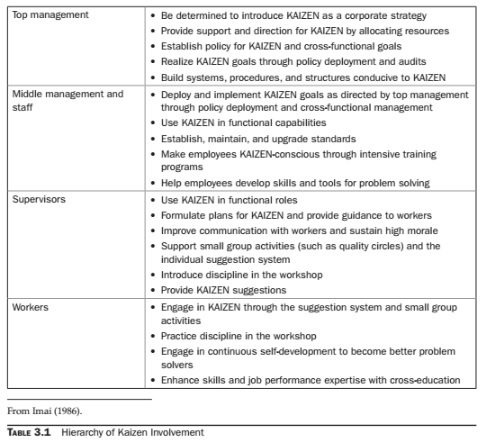
The figure illustrates both the shared responsibility and the limited role of KAIZEN in excluding radical innovations (sometimes referred to as reengineering). More detailed responsibilities for KAIZEN are provided in Table 3.1.